Innovation Project - BIOGLOW™ Challenge & Summer Prep
The Innovation Project challenge, 5-part framework, and Summer Prep media list for BIOGLOW™.
Table of Contents:
- The Challenge
- Capture Your Idea
- 5-Part Framework
- What to Focus On This Summer
- Media List - Movies & Podcasts to Explore the World of Biodiversity
- For Deeper Research (Advanced / Parents)
- Scoring Rubric Explained
Back to: FIRST® LEGO® League - 2026-27
The Innovation Project is one of the three judged components of every FLL season, alongside Robot Design and Core Values. Teams are challenged to identify a real-world problem connected to the season’s theme (biodiversity and ecosystems), research it thoroughly, design an original solution, and present it live to a panel of judges.
This year’s theme BIOGLOW™ is all about biodiversity and ecosystems.
The Challenge
Biodiversity keeps our planet healthy. In the rainforest, from the tiniest insects to towering trees, there are countless plant and animal species depending on one another to survive.
This season, your challenge is to:
“Identify a problem that puts biodiversity at risk and design an innovative solution that can help”
Capture Your Idea
For the upcoming season, follow this template to start building your idea as an individual, and use the remaining summer to do some research. Each member of the team will then present their idea at the start of the season and discuss among themselves which topic they want to eventually work on.
You are not working on the whole innovation project, but rather coming up with a list of problems and potential solutions for the innovation project. You’ll pitch the idea to the whole team and convince them why you are passionate about that idea, and then work on it as a team.
Prepare a live, engaging presentation to explain the work you have done, and why the team should work on that idea as an innovation project.
5-Part Framework
Work through these five stages as a team.
Identify: Clearly define the problem and do research.
- Choose a problem related to the prompt that interests your team. Clearly define what the problem is and why it matters.
- Research the problem and solutions that already exist. Use reliable sources to understand what works, what doesn’t, and what challenges remain.
Design: Work together to create a project plan and develop your ideas.
- Brainstorm possible ideas with your team. Could you create something new, adapt technology from another field, or improve an existing idea?
- Outline a project plan for how you will investigate, share, and refine your solution.
Create: Develop an original idea or build on an existing one with a prototype model/drawing.
- Clearly describe how your innovative solution addresses the problem you identified. What does it do? How does it impact biodiversity?
- Make a prototype model or drawing of your solution and plan to share it with others.
Iterate: Share your ideas with others, collect feedback, and make improvements to your solution.
- Share your ideas with other teams or mentors and gather feedback. Record what you learned and what you changed.
- Show evidence of improvements you made based on testing or feedback.
Communicate: Share an effective presentation of your solution, describe its impact on others, and celebrate your progress.
- Create a five-minute live presentation that describes your solution. Use the rubric as your guide.
- Highlight how your team uses Core Values and make sure every team member participates.
What to Focus On This Summer
Before the season starts students should try to get ahead by:
- Researching biodiversity topics they find interesting.
- Watching movies and listening to podcasts to build background knowledge.
- Identifying a problem they’re passionate about solving, the best projects start with genuine curiosity, not an assigned topic.
- Finding potential experts to interview, a local ecologist, conservation organization, or university researcher.
Multimedia Resources from FLL Team
Media List - Movies & Podcasts to Explore the World of Biodiversity
Some good movies, documentaries, and podcasts will help introduce kids to topics, and they can then decide to deeper-dive with their whole team on it. Everything below is PG-13 or under, but parent discretion is advised.
You can always visit the Glen Rock Public Library, or any BCCLS affiliated libraries to rent any of these below.
Radiolab (Podcast)
I’m personally a big fan of Radiolab, and it has covered a plethora of topics over the years. It’s a perfect accompaniment to a long road trip, or a ride to the beach.
You can listen to Radiolab on Spotify, Apple Podcasts, YouTube or original site
| Episode | Year | What It’s About |
|---|---|---|
| Zoos | 2007 | Captive breeding and conservation programs: can zoos actually help save species, or do they just preserve individuals? |
| Famous Tumors / Devil Tumors | 2010 | A contagious cancer is wiping out Tasmanian Devils, and low genetic diversity from inbreeding made the whole species vulnerable. |
| Argentine Invasion | 2012 | A single super-colony of Argentine ants has conquered every continent except Antarctica, annihilating local species wherever they land. |
| Galápagos | 2014 | Darwin’s islands are changing fast: invasive species, hybridizing finches, and possibly real-time speciation happening right now. |
| Worth | 2014 | Bats, bees, wetlands, and coral reefs do invisible work worth $142 trillion a year. What happens when we stop paying attention? |
| CRISPR | 2015 | A defense system hiding in bacteria for millions of years may let us rewrite DNA, and possibly resurrect extinct species. |
| From Tree to Shining Tree | 2016 | Underground fungal networks connect entire forests, letting trees share nutrients, send danger signals, and support dying neighbors. |
| Forests on Forests | 2022 | Tree canopies, long ignored by science, turn out to be entire ecosystems: sky gardens teeming with life above the forest floor. |
| The Honeybee Algorithm | 2024 | Honeybee foraging behavior inspired a solution to internet server crashes, with biodiversity encoded into the architecture of the web. |
| Bees | 2024 | Dr. Sammy Ramsey travels to Bangladesh to find how overlooked wild bee species might hold the key to saving honeybees worldwide. |
| Signal Hill: Caterpillar Roadshow | 2025 | A young boy cold-emails a professional entomologist and ends up collaborating with him. A great model for reaching out to your own expert. |
| Swimming with Shadows: A Week of Sharks | 2026 | Five-episode series shattering shark myths: glowing sharks, flying sharks, baby sharks, and shark antibodies that may cure cancer. |
Documentaries
| Title | Year | Rating | Theme(s) | Where to Watch |
|---|---|---|---|---|
| Planet Earth (Series) | 2006 | TV-G | Global ecosystems, species diversity, migration, human impact | Max / Peacock |
| Planet Earth II | 2016 | TV-G | Human impact on biodiversity, ecosystem resilience, conservation | Max |
| Planet Earth III | 2023 | TV-G | Human impact on biodiversity, ecosystem resilience, conservation | Max |
| Island of Lemurs: Madagascar | 2014 | G | Island biodiversity, endangered species, primate conservation | Available to rent |
| Jane | 2017 | PG-13 | Primatology, wildlife conservation, human-animal relationships | Disney+ / Nat Geo |
| Our Planet | 2019 | TV-G | Global biodiversity, habitat loss, climate change, conservation | Netflix |
| Fantastic Fungi | 2019 | NR | Fungal ecosystems, mycelium networks, biodiversity underground | Netflix / Kanopy |
YouTube
| Channels | Link | Topic |
|---|---|---|
| Kurzgesagt | World War Ant | Talks about ants and their war with each other |
Podcasts
You can listen to most podcast on Spotify, Apple Podcasts, YouTube or original site
| Podcast | Age Range | Episodes to Start With |
|---|---|---|
| Mongabay Newscast | Ages 13+ | Any recent episode. This is a live feed of real biodiversity threats worldwide, one of the fastest ways to find a problem worth solving. |
| Terrestrials (by Radiolab) | All ages | “From Tree to Shining Tree” (fungal forest networks); “Woolly Aphids” |
| Brains On! | Ages 6-12 | Search: “ecosystems,” “bees,” “forests” |
| Earth Rangers | Ages 6-12 | Any episode; all are conservation-focused |
| Ologies with Alie Ward The original Ologies episodes have curse words. |
Ages 12+ | • Melittology (bees) • Ornithology (birds) • Cheloniology (sea turtles) • Conservation Technology • Critical Ecology • Aquaculture Ecology • Macrophycology (seaweed) |
| The Infinite Monkey Cage (BBC) | Ages 13+ | • “Is Extinction the End?” (de-extinction, woolly mammoths, ecosystem restoration) • Bees vs Wasps |
Biosphere 2 — Closed Ecosystems
Background: In 1991, eight people sealed themselves inside Biosphere 2, a 7.2-million-cubic-foot glass facility in Oracle, Arizona. Containing a rainforest, savannah, coral reef ocean, desert, farm, and over 3,800 species, they stayed for two years. It remains the most biodiverse closed ecological system ever built, and is now a University of Arizona research facility studying climate, ecosystems, and space habitation.
| Episode | Podcast | Year | What It’s About |
|---|---|---|---|
| SAM: Space Analog for Moon & Mars | Biosphere 2 Podcast | 2023 | Kai Staats explains SAM, a sealed Mars habitat built at Biosphere 2. If you had to pack an ecosystem for another planet, what would you bring? |
| Biosphere 2: The Theater of Utopia | Nice Try! | 2019 | Eight people, five biomes, two years sealed inside. What actually happened, and was it really a failure? One mild language note. |
Movies
| Title | Year | Rating | Theme(s) | Where to Watch |
|---|---|---|---|---|
| Hoppers | 2026 | PG | Wetland ecosystems, habitat loss, biodiversity, species interdependence, human vs. nature | Disney+ |
| FernGully: The Last Rainforest | 1992 | G | Rainforest biodiversity, deforestation, pollution, habitat destruction | Amazon Prime Video |
| Hoot | 2006 | PG | Endangered species, habitat protection, youth activism, conservation | Amazon Prime Video |
| The Lorax | 2012 | PG | Deforestation, ecosystem collapse, natural resource conservation, sustainability | Peacock |
| Rio | 2011 | G | Endangered species, animal trafficking, tropical biodiversity, rainforest | Disney+ |
| Happy Feet | 2006 | PG | Antarctic ecosystem, overfishing, ocean pollution, plastic waste, climate impact | Max |
| WALL-E | 2008 | G | Habitat destruction, pollution, human consumption, ecosystem collapse | Disney+ |
| Bambi | 1942 | G | Forest ecosystems, wildlife survival, human impact on nature | Disney+ |
| Pom Poko (Studio Ghibli) |
1994 | PG | Urban development vs. wildlife habitat, species displacement, conservation | Max |
For Deeper Research (Advanced / Parents)
| Podcast | Platform | What It Covers |
|---|---|---|
| Inside Biodiversity | Apple · Spotify | In-depth conversations with leading biodiversity researchers on species extinctions, ecosystem resilience, and conservation policy. Launched 2025. |
| Rewilding Earth | Apple · Spotify | Conservationists, biologists, and activists working on wilderness restoration and species reintroduction. |
Everything on this list will help students with identify a problem and put a starting point for their research. The podcasts especially are great for finding an expert to interview, many episode guests are university professors, field scientists, and conservationists who are active in public outreach and often willing to speak with student teams.
By no means this is an exhaustive list, there are tons of other resources out there. If you have a suggestion to add to the list, please send us an email, and we’ll be happy to include it.
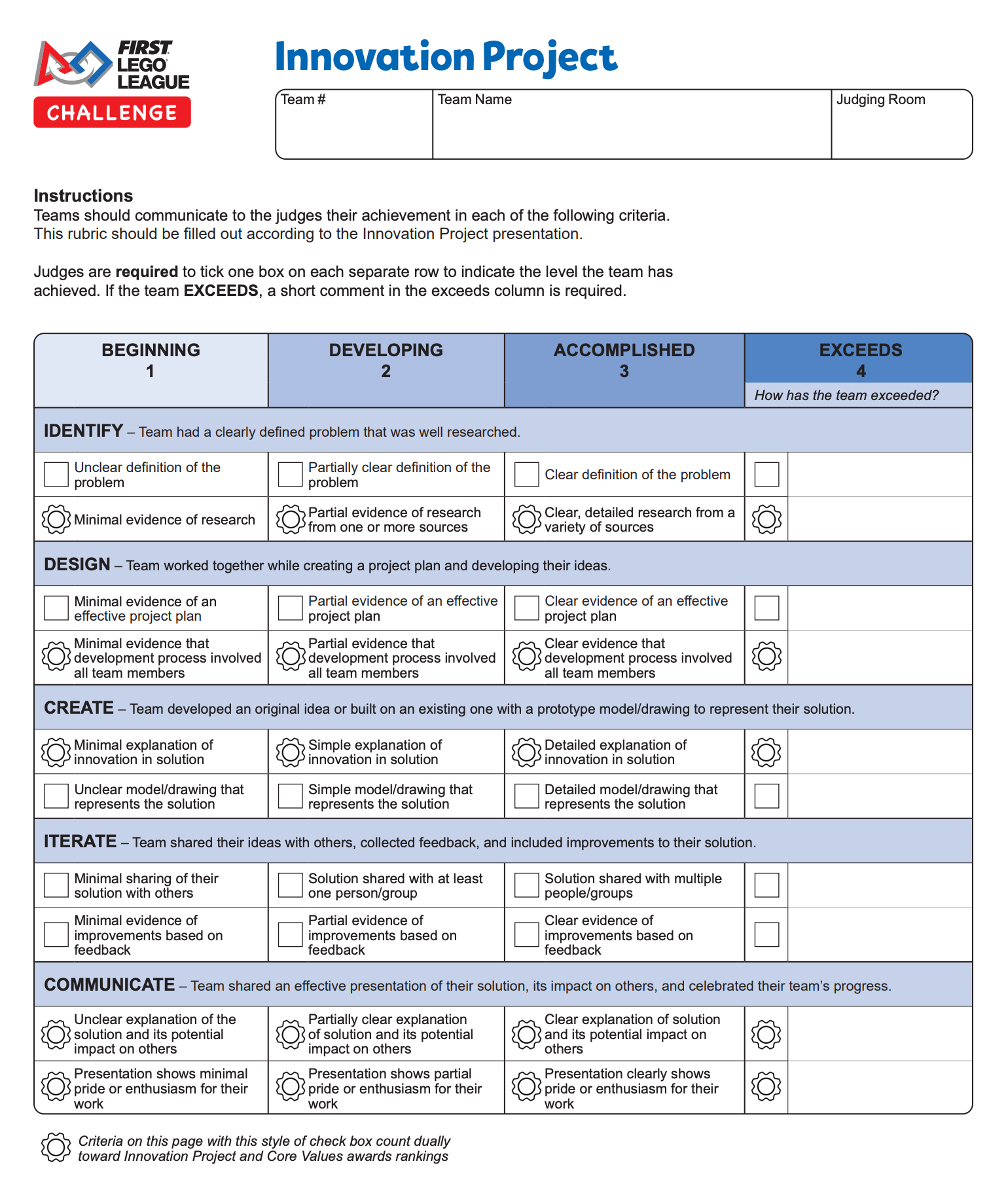
Scoring Rubric Explained
The project is evaluated across five criteria, and a four-level scale:
- Identify: Team had a clearly defined problem that was well researched.
- Design: Team worked together while creating a project plan and developing their ideas.
- Create: Team developed an original idea or built on an existing one, with a prototype model or drawing to represent their solution.
- Iterate: Team shared their ideas with others, collected feedback, and included improvements to their solution.
- Communicate: Team shared an effective presentation of their solution, its impact on others, and celebrated their team’s progress.
One key requirement students often underestimate: Sharing the solution with real people outside the team, ideally an expert in the field. This separates a “Developing” team from an “Accomplished” team. The Innovation Project is also where Core Values (teamwork, discovery, inclusion, innovation, impact, and fun) are evaluated, making up 25% of a team’s overall Champion’s score.